In mathematics, the Banach fixed-point theorem (also known as the contraction mapping theorem or contractive mapping theorem or Banach–Caccioppoli theorem) is an important tool in the theory of metric spaces; it guarantees the existence and uniqueness of fixed points of certain self-maps of metric spaces and provides a constructive method to find those fixed points. It can be understood as an abstract formulation of Picard's method of successive approximations.[1] The theorem is named after Stefan Banach (1892–1945) who first stated it in 1922.[2][3]
Statement
[edit]Definition. Let be a metric space with metric . Then a map is called a contraction mapping on if there exists a nonnegative constant such that


for all

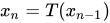
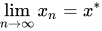
Banach fixed-point theorem. Let be a non-empty complete metric space with a contraction mapping Then admits a unique fixed point , meaning . Furthermore, can be found as follows: start with an arbitrary element and define for Then .



Remark 1. The following inequalities are equivalent and describe the speed of convergence:
![{\displaystyle {\begin{aligned}d(x^{*},x_{n})&\leq q^{n}d(x^{*},x_{0}),\\[5pt]d(x^{*},x_{n})&\leq {\frac {q^{n}}{1-q}}d(x_{1},x_{0}),\\[5pt]d(x^{*},x_{n+1})&\leq {\frac {q}{1-q}}d(x_{n+1},x_{n}),\\[5pt]d(x^{*},x_{n+1})&\leq q\,d(x^{*},x_{n}).\end{aligned}}}](https://wikimedia.org/api/rest_v1/media/math/render/svg/973e5064227f3c02731a1cf04a2a65d438de4e46)
The value is called a Lipschitz constant for , and a minimal such is sometimes called "the best Lipschitz constant" of .

Remark 2. The condition for all is in general not enough to ensure the existence of a fixed point, as is shown by the map which lacks a fixed point. However, if is compact, then this weaker condition does imply the existence and uniqueness of a fixed point which can be easily found as a minimizer of : indeed, a minimizer exists by compactness, and must be a fixed point. It then easily follows that the fixed point is the limit of any sequence of iterations of .




Remark 3. When using the theorem in practice, the most difficult part is typically to define properly so that .

Proof
[edit]Let be arbitrary and define a sequence by setting . We first note that for all we have the inequality



This follows by induction on , using the fact that is a contraction mapping. Then we can show that is a Cauchy sequence. In particular, let such that :


![{\displaystyle {\begin{aligned}d(x_{m},x_{n})&\leq d(x_{m},x_{m-1})+d(x_{m-1},x_{m-2})+\cdots +d(x_{n+1},x_{n})\\[5pt]&\leq q^{m-1}d(x_{1},x_{0})+q^{m-2}d(x_{1},x_{0})+\cdots +q^{n}d(x_{1},x_{0})\\[5pt]&=q^{n}d(x_{1},x_{0})\sum _{k=0}^{m-n-1}q^{k}\\[5pt]&\leq q^{n}d(x_{1},x_{0})\sum _{k=0}^{\infty }q^{k}\\[5pt]&=q^{n}d(x_{1},x_{0})\left({\frac {1}{1-q}}\right).\end{aligned}}}](https://wikimedia.org/api/rest_v1/media/math/render/svg/e312b2b273313353cfe1a228cf5e407956b8b8f6)
Let be arbitrary. Since , we can find a large so that


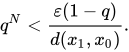
Therefore, by choosing and greater than we may write:



This proves that the sequence is Cauchy. By completeness of , the sequence has a limit Furthermore, must be a fixed point of :


As a contraction mapping, is continuous, so bringing the limit inside was justified. Lastly, cannot have more than one fixed point in , since any pair of distinct fixed points and would contradict the contraction of :


where the equality is due to being fixed points of , the first inequality is due to being a contraction mapping, and the last inequality is due to and as .


Applications
[edit]- A standard application is the proof of the Picard–Lindelöf theorem about the existence and uniqueness of solutions to certain ordinary differential equations. The sought solution of the differential equation is expressed as a fixed point of a suitable integral operator on the space of continuous functions under the uniform norm. The Banach fixed-point theorem is then used to show that this integral operator has a unique fixed point.
- One consequence of the Banach fixed-point theorem is that small Lipschitz perturbations of the identity are bi-lipschitz homeomorphisms. Let be an open set of a Banach space ; let denote the identity (inclusion) map and let be a Lipschitz map of constant . Then


- is an open subset of : precisely, for any in such that one has ;
- is a bi-Lipschitz homeomorphism;


- precisely, is still of the form with a Lipschitz map of constant . A direct consequence of this result yields the proof of the inverse function theorem.


- It can be used to give sufficient conditions under which Newton's method of successive approximations is guaranteed to work, and similarly for Chebyshev's third-order method.
- It can be used to prove existence and uniqueness of solutions to integral equations.
- It can be used to give a proof to the Nash embedding theorem.[4]
- It can be used to prove existence and uniqueness of solutions to value iteration, policy iteration, and policy evaluation of reinforcement learning.[5]
- It can be used to prove existence and uniqueness of an equilibrium in Cournot competition,[6] and other dynamic economic models.[7]
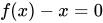
- If X is a vector space, an alternative method for iteratively approximating the fixed point is to apply Newton's method to solve .
- One real world illustration of the theorem is the following demonstration that can often be understood with little formal mathematics background. Suppose a person holds a sheet of paper on which is printed a map of the city they are in (or a map of their country, or a blueprint of the building they are in, etc.). The person then places the map on the floor. This can be considered to represent a continuous function from the city to itself and is clearly a contraction. Therefore, there is exactly one point in the map that lies directly above the point that it represents. The accuracy of the map and projection method do not matter as long as the map is complete and all points represented are moved closer together in the projection. What's more, should the person scrunch the map up into a ball and flatten it on the floor, as long as the paper does not tear, this will still be a contraction and the same conclusion can be reached.
Converses
[edit]Several converses of the Banach contraction principle exist. The following is due to Czesław Bessaga, from 1959:
Let be a map of an abstract set such that each iterate has a unique fixed point. Let , then there exists a complete metric on such that is contractive, and is the contraction constant.


Indeed, very weak assumptions suffice to obtain such a kind of converse. For example if is a map on a T1 topological space with a unique fixed point , such that for each we have , then there already exists a metric on with respect to which satisfies the conditions of the Banach contraction principle with contraction constant .[8] In this case the metric is in fact an ultrametric.


Generalizations
[edit]There are a number of generalizations (some of which are immediate corollaries).[9]
Let be a map on a complete non-empty metric space. Then, for example, some generalizations of the Banach fixed-point theorem are:

- Assume that some iterate of is a contraction. Then has a unique fixed point.
- Assume that for each , there exist such that for all and , and that


- Then has a unique fixed point.
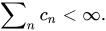
In applications, the existence and uniqueness of a fixed point often can be shown directly with the standard Banach fixed point theorem, by a suitable choice of the metric that makes the map a contraction. Indeed, the above result by Bessaga strongly suggests to look for such a metric. See also the article on fixed point theorems in infinite-dimensional spaces for generalizations.
In a non-empty compact metric space, any function satisfying for all distinct , has a unique fixed point. The proof is simpler than the Banach theorem, because the function is continuous, and therefore assumes a minimum, which is easily shown to be zero.


A different class of generalizations arise from suitable generalizations of the notion of metric space, e.g. by weakening the defining axioms for the notion of metric.[10] Some of these have applications, e.g., in the theory of programming semantics in theoretical computer science.[11]
Example
[edit]An application of the Banach fixed-point theorem and fixed-point iteration can be used to quickly obtain an approximation of with high accuracy. Consider the function . It can be verified that is a fixed point of , and that maps the interval to itself. Moreover, , and it can be verified that


![{\displaystyle \left[{\frac {3\pi }{4}},{\frac {5\pi }{4}}\right]}](https://wikimedia.org/api/rest_v1/media/math/render/svg/09352fbeed7d3a155bde370dcd701ba691b1faaa)


on this interval. Therefore, by an application of the mean value theorem, has a Lipschitz constant less than (namely ). Applying the Banach fixed-point theorem shows that the fixed point is the unique fixed point on the interval, allowing for fixed-point iteration to be used.


For example, the value may be chosen to start the fixed-point iteration, as . The Banach fixed-point theorem may be used to conclude that


Applying to only thrice already yields an expansion of accurate up to digits:

![{\displaystyle {\begin{matrix}\operatorname {id} (3)&=&f^{[0]}\!(3)&=&{\boldsymbol {3.}}0000000000000000000000000000000000\cdots \\f(3)&=&f^{[1]}\!(3)&=&{\boldsymbol {3.141}}1200080598672221007448028081103\cdots \\f{\big (}f(3){\big )}&=&f^{[2]}\!(3)&=&{\boldsymbol {3.1415926535}}721955587348885681408797\cdots \\f{\Big (}f{\big (}f(3){\big )}{\Big )}&=&f^{[3]}\!(3)&=&{\boldsymbol {3.14159265358979323846264338327950}}20\cdots \end{matrix}}}](https://wikimedia.org/api/rest_v1/media/math/render/svg/c7738229138611a19b3fdfbfc1a9e47b1412f40d)
See also
[edit]Notes
[edit]- ^ Kinderlehrer, David; Stampacchia, Guido (1980). "Variational Inequalities in RN". An Introduction to Variational Inequalities and Their Applications. New York: Academic Press. pp. 7–22. ISBN 0-12-407350-6.
- ^ Banach, Stefan (1922). "Sur les opérations dans les ensembles abstraits et leur application aux équations intégrales" (PDF). Fundamenta Mathematicae. 3: 133–181. doi:10.4064/fm-3-1-133-181. Archived (PDF) from the original on 2011-06-07.
- ^ Ciesielski, Krzysztof (2007). "On Stefan Banach and some of his results" (PDF). Banach J. Math. Anal. 1 (1): 1–10. doi:10.15352/bjma/1240321550. Archived (PDF) from the original on 2009-05-30.
- ^ Günther, Matthias (1989). "Zum Einbettungssatz von J. Nash" [On the embedding theorem of J. Nash]. Mathematische Nachrichten (in German). 144: 165–187. doi:10.1002/mana.19891440113. MR 1037168.
- ^ Lewis, Frank L.; Vrabie, Draguna; Syrmos, Vassilis L. (2012). "Reinforcement Learning and Optimal Adaptive Control". Optimal Control. New York: John Wiley & Sons. pp. 461–517 [p. 474]. ISBN 978-1-118-12272-3.
- ^ Long, Ngo Van; Soubeyran, Antoine (2000). "Existence and Uniqueness of Cournot Equilibrium: A Contraction Mapping Approach" (PDF). Economics Letters. 67 (3): 345–348. doi:10.1016/S0165-1765(00)00211-1. Archived (PDF) from the original on 2004-12-30.
- ^ Stokey, Nancy L.; Lucas, Robert E. Jr. (1989). Recursive Methods in Economic Dynamics. Cambridge: Harvard University Press. pp. 508–516. ISBN 0-674-75096-9.
- ^ Hitzler, Pascal; Seda, Anthony K. (2001). "A 'Converse' of the Banach Contraction Mapping Theorem". Journal of Electrical Engineering. 52 (10/s): 3–6.
- ^ Latif, Abdul (2014). "Banach Contraction Principle and its Generalizations". Topics in Fixed Point Theory. Springer. pp. 33–64. doi:10.1007/978-3-319-01586-6_2. ISBN 978-3-319-01585-9.
- ^ Hitzler, Pascal; Seda, Anthony (2010). Mathematical Aspects of Logic Programming Semantics. Chapman and Hall/CRC. ISBN 978-1-4398-2961-5.
- ^ Seda, Anthony K.; Hitzler, Pascal (2010). "Generalized Distance Functions in the Theory of Computation". The Computer Journal. 53 (4): 443–464. doi:10.1093/comjnl/bxm108.
References
[edit]- Agarwal, Praveen; Jleli, Mohamed; Samet, Bessem (2018). "Banach Contraction Principle and Applications". Fixed Point Theory in Metric Spaces. Singapore: Springer. pp. 1–23. doi:10.1007/978-981-13-2913-5_1. ISBN 978-981-13-2912-8.
- Chicone, Carmen (2006). "Contraction". Ordinary Differential Equations with Applications (2nd ed.). New York: Springer. pp. 121–135. ISBN 0-387-30769-9.
- Granas, Andrzej; Dugundji, James (2003). Fixed Point Theory. New York: Springer-Verlag. ISBN 0-387-00173-5.
- Istrăţescu, Vasile I. (1981). Fixed Point Theory: An Introduction. The Netherlands: D. Reidel. ISBN 90-277-1224-7. See chapter 7.
- Kirk, William A.; Khamsi, Mohamed A. (2001). An Introduction to Metric Spaces and Fixed Point Theory. New York: John Wiley. ISBN 0-471-41825-0.
This article incorporates material from Banach fixed point theorem on PlanetMath, which is licensed under the Creative Commons Attribution/Share-Alike License.
| Fields |  | |
|---|---|---|
| Key concepts | ||
| Metrics and properties | ||
| Key results | ||


