The Riemann hypothesis is one of the most important conjectures in mathematics. It is a statement about the zeros of the Riemann zeta function. Various geometrical and arithmetical objects can be described by so-called global L-functions, which are formally similar to the Riemann zeta-function. One can then ask the same question about the zeros of these L-functions, yielding various generalizations of the Riemann hypothesis. Many mathematicians believe these generalizations of the Riemann hypothesis to be true. The only cases of these conjectures which have been proven occur in the algebraic function field case (not the number field case).
Global L-functions can be associated to elliptic curves, number fields (in which case they are called Dedekind zeta-functions), Maass forms, and Dirichlet characters (in which case they are called Dirichlet L-functions). When the Riemann hypothesis is formulated for Dedekind zeta-functions, it is known as the extended Riemann hypothesis (ERH) and when it is formulated for Dirichlet L-functions, it is known as the generalised Riemann hypothesis (GRH). Another approach to generalization of Riemann hypothesis was given by Atle Selberg and his introduction of class of function satisfying certain properties rather than specific functions, nowadays known as Selberg class. These three statements will be discussed in more detail below. (Many mathematicians use the label generalized Riemann hypothesis to cover the extension of the Riemann hypothesis to all global L-functions, not only the special case of Dirichlet L-functions.)
Generalized Riemann hypothesis (GRH)
[edit]The Generalized Riemann hypothesis asserts that all nontrivial zeros of Dirichlet L-function for primitive Dirichlet character have real part .


The generalized Riemann hypothesis for Dirichlet L-functions was probably formulated for the first time by Adolf Piltz in 1884.[1] It is important to assume primitivity of the character, since for nonprimitive characters, L-functions have infinitely many zeros off this line and do not satisfy the functional equation that is used to distinguish between trivial and nontrivial zeros.[2]
Background
[edit]A Dirichlet character of modulus q is an arithmetic function that is:

- completely multiplicative:
- periodic:
- if and only if .




For such a character , we define the corresponding Dirichlet L-function by:

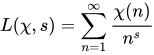
For every complex number s such that Re s > 1 this series is absolutely convergent. By analytic continuation, this function can be extended to a meromorphic function on the complex plane having only a possible pole in , when the character is principal (has only 1 as value for numbers coprime to k). For nonprincipal characters, the series is conditionally convergent for and the analytic continuation is an entire function.


We say that the Dirichlet character is inprimitive if it is induced by another Dirichlet character of lesser modulus:


Otherwise we say that the character is primitive. Generally most statements for Dirichlet L-functions are easier to express for versions with primitive characters. Using Euler products of Dirichlet L-functions, we can express the L-function of an imprimitive character as a function of the character that induces it:
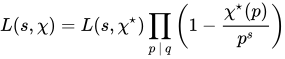
From the factors in this equation we have infinitely many zeros on the line . For primitive Dirichlet character, the L-function satisfies a certain functional equation which allows us to define trivial zeros of as zeros corresponding to poles of the gamma function in this equation:


- If , then all trivial zeros are simple zeros in negative even numbers. If it also includes 0.
- If then all trivial zeros are simple zeros in negative odd numbers.


Any other zeros are called nontrivial zeros. The functional equation guarantees that nontrivial zeros lie in the critical strip and are symmetric with respect to the critical line . The Generalized Riemann Hypothesis says that all nontrivial zeros lie exactly on this line.


Consequences of GRH
[edit]Like the original Riemann hypothesis, the GRH has far-reaching consequences about the distribution of prime numbers:
- Taking the trivial character yields the ordinary Riemann hypothesis.
- More effective version of Dirichlet's theorem on arithmetic progressions: Let where a and d are coprime denote the number of prime numbers in arithmetic progression which are less than or equal to x. If the generalized Riemann hypothesis is true, then for every ε > 0:


- where is Euler's totient function and is the Big O notation. This is a considerable strengthening of the prime number theorem.



- Every proper subgroup of the multiplicative group has a set of generators less than . In other words, every subgroup of multiplicative group omits a number less than , as well as a number coprime to less than .[3] This has many consequences in computational number theory:
- In 1976, G. Miller showed that the Miller-Rabin test is guaranteed to run in polynomial time.
- The Shanks–Tonelli algorithm is guaranteed to run in polynomial time.
- The Ivanyos–Karpinski–Saxena deterministic algorithm[4] for factoring polynomials over finite fields with prime constant-smooth degrees is guaranteed to run in polynomial time.




Extended Riemann hypothesis (ERH)
[edit]Suppose is a number field with ring of integers (this ring is the integral closure of the integers in K). If is a nonzero ideal of , we denote its norm by . The Dedekind zeta-function of K is then defined by:


for every complex number s with real part > 1. The sum extends over all non-zero ideals of . That function can be extended by analytic continuation to the meromorphic function on complex plane with only possible pole at and satisfies a functional equation that gives exact location of trivial zeroes and guarantees that nontrivial zeros lie inside critical strip and are symmetric with respect to critical line: .

The extended Riemann hypothesis asserts that for every number field K each nontrivial zero of has real part (and thus lies on the critical line).


Consequences of ERH
[edit]- The ordinary Riemann hypothesis follows from the extended one if one takes the number field to be , whose ring of integers is: .
- Generalized Riemann hypothesis for Dirichlet L-functions is equivalent to ERH for K being abelian extension of rational numbers, since for abelian extensions is finite product of some Dirichlet L-functions depending on K. Conversely, all L-functions for character modulo n appears in product for , where is n-th primitive root of unity.
- For general extensions, similar role to Dirichlet L-functions is played by Artin L-functions. Then, ERH is equivalent to Riemann Hypothesis for Artin L-functions.
- The ERH implies an effective version[9] of the Chebotarev density theorem: if L/K is a finite Galois extension with Galois group G, and C a union of conjugacy classes of G, the number of unramified primes of K of norm below x with Frobenius conjugacy class in C is


- where the constant implied in the big-O notation is absolute, n is the degree of L over Q, and Δ its discriminant.

- Weinberger (1973) showed that ERH implies that any number field with class number 1 is either Euclidean or an imaginary quadratic number field of discriminant −19, −43, −67, or −163.
- Odlyzko (1990) discussed how the ERH can be used to give sharper estimates for discriminants and class numbers of number fields.
Generalized Riemann hypothesis for Selberg class
[edit]Selberg class is defined the following way:
We say that Dirichlet series is in Selberg class if it satisfies following properties:

- Analyticity: has a meromorphic continuation to the entire complex plane, with the only possible pole (if any) in .
- Ramanujan conjecture: a1 = 1 and for any ε > 0;
- Functional equation: there is a gamma factor of the form


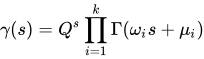
where is real and positive, the gamma function, the real and positive, and the complex with non-negative real part, as well as a so-called root number: , such that the function:



satisfies:

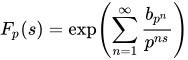
- Euler product: For Re(s) > 1, F(s) can be written as a product over primes:
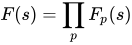
with
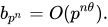
and, for some ,

From analyticity follows that poles of gamma factor in must be cancelled by zeros of , that zeros are called trivial zeros. Functional equation guarantees that all nontrivial zeros lie in critical strip and are symmetric with respect to critical line .


Generalized Riemann hypothesis for Selberg class states that all nontrivial zeros of function belonging to Selberg class have real part and then lie on critical line.

Selberg class along with proposition of Riemann hypothesis for it was firs introduced in (Selberg 1992). Instead of considering specific functions, Selberg approach was to give axiomatic definition consisting of properties characterizing most of objects called L-functions or zeta functions and expected to satisfy counterparts or generalizations of Riemann hypothesis.
Consequences
[edit]- Artin L-functions and Dedekind zeta functions belong to Selberg class, then Riemann Hypothesis for Selberg class implies extended Riemann hypothesis.
- Nontrivial zeros for much more general L-functions than Dedekind zeta functions lie on critical lines. One example can be Ramanujan L-function related to modular form called Dedekind eta function. Despite Ramanujan L-function itself don't belong to Selberg class and its critical line is , function obtained by translation of is in Selberg class.


See also
[edit]- Artin's conjecture
- Artin L-function
- Dirichlet L-function
- Dedekind zeta function
- Selberg class
- Grand Riemann hypothesis
References
[edit]- ^ Davenport, Harold (2000). Multiplicative Number Theory. Graduate Texts in Mathematics. Vol. 74. Revised and with a preface by Hugh L. Montgomery (Third ed.). New York: Springer-Verlag. p. 124. ISBN 0-387-95097-4.
- ^ Rohrlich, David E. (2011). "Root numbers" (PDF). Arithmetic of L-functions. IAS/Park City Mathematics Series. Vol. 18. Providence, Rhode Island: American Mathematical Society. pp. 353–448. doi:10.1090/pcms/018/13. ISBN 978-0-8218-5320-7. MR 2882696. See Exercise 1.1, pp. 374–375 (p. 23 of preprint version).
- ^ Bach, Eric (1990). "Explicit bounds for primality testing and related problems". Mathematics of Computation. 55 (191): 355–380. doi:10.2307/2008811. JSTOR 2008811.
- ^ Ivanyos, Gabor; Karpinski, Marek; Saxena, Nitin (2009). "Schemes for deterministic polynomial factoring". Proceedings of the 2009 international symposium on Symbolic and algebraic computation (ISAAC). pp. 191–198. arXiv:0804.1974. doi:10.1145/1576702.1576730. ISBN 9781605586090. S2CID 15895636.
- ^ Shoup, Victor (1992). "Searching for primitive roots in finite fields". Mathematics of Computation. 58 (197): 369–380. doi:10.2307/2153041. JSTOR 2153041.
- ^ p5. Helfgott, Harald (2013). "Major arcs for Goldbach's theorem". arXiv:1305.2897 [math.NT].
- ^ "Caltech Mathematicians Solve 19th Century Number Riddle". California Institute of Technology. October 31, 2022.
- ^ Dunn, Alexander; Radziwiłł, Maksym (2021). "Bias in cubic Gauss sums: Patterson's conjecture". arXiv:2109.07463 [math.NT].
- ^ Lagarias, J.C.; Odlyzko, A.M. (1977). "Effective Versions of the Chebotarev Theorem". Algebraic Number Fields: 409–464.
- Ono, Ken; Soundararajan, K. (1997), "Ramanujan's ternary quadratic form", Inventiones Mathematicae, 130 (3): 415–454, Bibcode:1997InMat.130..415O, doi:10.1007/s002220050191, S2CID 122314044
- Odlyzko, A. M. (1990), "Bounds for discriminants and related estimates for class numbers, regulators and zeros of zeta functions: a survey of recent results", Séminaire de Théorie des Nombres de Bordeaux, Série 2, 2 (1): 119–141, doi:10.5802/jtnb.22 (inactive 17 December 2025), MR 1061762
{{citation}}: CS1 maint: DOI inactive as of December 2025 (link) - Weinberger, Peter J. (1973), "On Euclidean rings of algebraic integers", Analytic number theory ( St. Louis Univ., 1972), Proc. Sympos. Pure Math., vol. 24, Providence, R.I.: Amer. Math. Soc., pp. 321–332, MR 0337902
- Selberg, Atle (1992), "Old and new conjectures and results about a class of Dirichlet series", Proceedings of the Amalfi Conference on Analytic Number Theory (Maiori, 1989), Salerno: Univ. Salerno, pp. 367–385, MR 1220477, Zbl 0787.11037 Reprinted in Collected Papers, vol 2, Springer-Verlag, Berlin (1991)
